A Cup’s Long Journey: Materials, Makers and Meaning
Follow a cup’s route through materials, making, sale and everyday use, and keep what you know separate from guesses about its origin.
Where does a cup’s story begin if its clay, maker, shop and household are in different places? A cup’s journey is easier to describe when you trace the decisions that shaped it, rather than trying to assign it one birthplace.
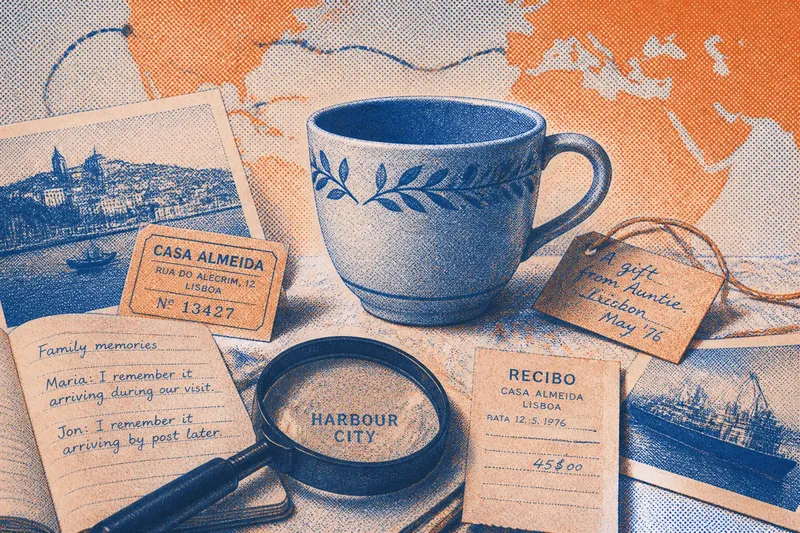
Start with evidence you can point to: a maker’s mark, a receipt, an old label, or a family memory. Keep each clue tied to the particular part of the story it supports. A shop label can show where someone bought the cup; it cannot, by itself, identify the workshop that made it.
Describe visible clues
Write down the cup’s material, shape, decoration and condition. Note whether it is ceramic, glass, metal, wood or a combination, and record features such as a handle, lid, foot or pouring lip. Photograph the base and any marks in clear light.
Transcribe stamps, stickers and handwritten notes exactly, including uncertain letters. A mark may name a maker, importer, distributor or retailer. Avoid treating a place name as a complete account of the cup’s history until you know what the label refers to.
For instance, “blue-glazed ceramic cup, small impressed mark on base” is a useful description. “Traditional cup from the coast” is a claim that needs evidence. If the cup is fragile or valuable, do not scrape or soak it to uncover a mark; ask a conservator or suitable specialist before attempting treatment.
Trace its design choices
A cup’s form reflects practical decisions as well as style. A handle changes how it is held; a lid may help contain heat or spills; a broad opening makes the contents easier to reach. These features can suggest how a cup was meant to work, but they do not establish where it was made or who used it.
Decoration needs similar care. Describe a pattern by its visible features before trying to name its source. A motif may be adapted, copied or commissioned for customers elsewhere. Do not identify a design with a whole culture based on resemblance alone.
Separate what you see from what you infer. “Repeated blue leaves around the rim” is an observation; “made by a particular community” is an attribution that needs a reliable source connected to this cup.
Read labels and records
Look for information from the named maker, a reputable collection catalogue or a reliable record associated with the cup. Compare the source’s details with the mark, shape and decoration on your object. A similar-looking item is not necessarily the same model or product.
- If a maker’s name is legible, compare its spelling and mark with a maker’s own catalogue; if they match, record the attribution with the source, but if they do not, leave the maker unidentified.
- If a country name appears on the base, check whether a maker or distributor explains the label; if its meaning is clear, record that limited claim, but if it is not, transcribe the stamp without assigning it to a particular production stage.
- If an old price tag or shop sticker survives, note the retailer and any place named; if it identifies a seller, record where the cup was sold, but if it gives no location, preserve the wording without inferring one.
- If a receipt names a shop and purchase, keep it with the cup’s record; if it supports a particular sale, describe that transaction, but if the date or item is unclear, do not use it to date the cup.
- If a family note identifies a giver or occasion, record who wrote it and what it says; if the account is specific, attribute it to that person, but if it is uncertain, mark it as family recollection rather than fact.
- If two catalogue entries disagree, save the details and sources for both; if one directly matches the cup’s marks, explain why you favour it, but if neither does, preserve the disagreement and leave the identification open.
Say you find an undecorated cup with a stamped city name but no maker. You photograph the stamp, transcribe it as “Harbour City”, then search the name alongside “cup maker” and check a local collection catalogue. If the catalogue describes a different mark, you note that the match is unresolved rather than claiming the cup was made there. The result is a record that captures the clue without stretching it.
Record changes at home
A cup’s household story can be more personal than its maker’s record. It may arrive as a gift, move with a family, serve a different purpose or remain unused on a shelf. Record who remembers each event and distinguish a direct memory from a story passed on by someone else.
Imagine a family has a cup with a shop sticker from Lisbon and a note saying it was a present from an aunt. One relative remembers it arriving during a visit; another remembers receiving it later by post. Keep both accounts attributed to their speakers, and record the sticker as evidence of a seller only if it names one. The disagreement does not establish where the cup was made, and there is no need to force a single timeline.
Wear can show that an object has changed, but it rarely identifies a person or place. Describe a faded rim or repaired handle plainly. If you know who repaired it, record the source of that information; otherwise, leave the repair’s date and maker unknown.
When records disagree?
What if the cup has no mark?
Describe its material, form and decoration, then search for a distinctive combination of features. If no reliable match appears, record the maker and origin as unknown rather than treating a resemblance as proof.
Does a place name prove where it was made?
Not by itself: the name might refer to a seller, distributor or another part of the product record. Look for an explanation from the maker or a dependable catalogue before assigning it a specific meaning.
Can a pattern identify its cultural source?
It can provide a clue, but similar designs travel and change. Describe the pattern first, and make a cultural attribution only when a reliable source connects the design on this cup to that context.
What if family accounts conflict?
Write down who remembers each version and keep the accounts separate. One may describe a gift while another remembers a later transfer; if the difference cannot be resolved, leave the sequence open.
Keep a useful record
Keep a short description, photographs, exact transcriptions of marks and notes about where the cup is now. Add the source beside each claim, such as a receipt, catalogue entry or named relative’s recollection. If new evidence turns up, add it without erasing what you originally observed.
It is not worth assigning an origin from colour, shape or vague resemblance alone. Those guesses can obscure the more useful details: what the cup itself shows, what its records say and which parts of its story remain uncertain.
When someone asks for the cup’s story, describe the evidence in ordinary language: the mark it bears, the record that identifies a seller, or the family account of how it arrived. Using “unknown” for anything the clues cannot settle makes the account more useful, not less.