Why Ideas Rarely Travel Alone
Why ideas travel rarely has one answer. Trace a neighbourhood noticeboard from first proposal to local practice and see how exchange changes an idea.
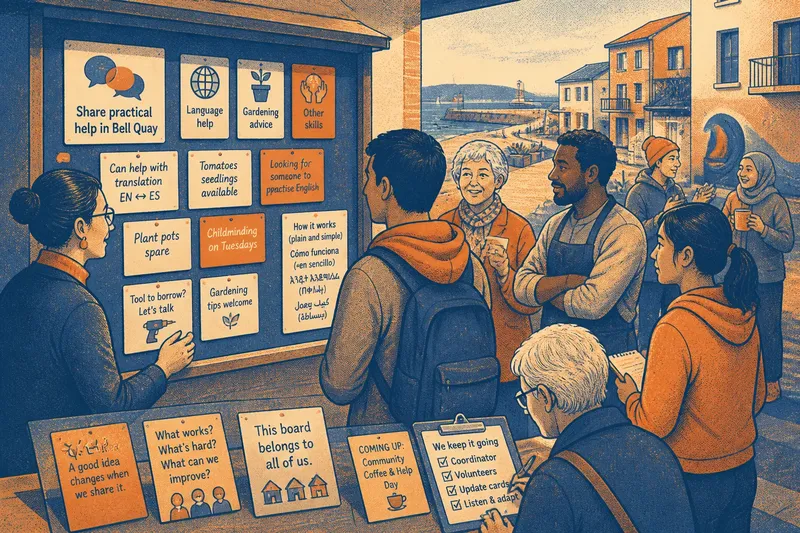
Why do ideas travel rarely with one clear origin? A neighbourhood noticeboard can begin with one person’s proposal, yet its useful form may depend on many conversations, borrowed practices and local decisions. Following an invented project shows how to tell that story without turning one contributor into its sole author.
A proposal takes shape
Imagine residents of an invented coastal neighbourhood, Bell Quay, want a simple way to share practical help. People speak different first languages, and not everyone uses the same online platforms. At a planning meeting, a librarian proposes a public noticeboard where neighbours can offer things such as translation help or plant pots.
The librarian raised the proposal, named it and sketched a first version. Those are specific contributions, but they are not the whole history. She had seen a similar board at a community centre, heard residents describe informal message chains, and remembered a colleague’s account of a paper exchange in another town.
Those encounters did not provide a finished design. They supplied elements the librarian brought together: a public display, a way to offer help and an option that did not require joining a group chat. The project’s local beginning is clear; its wider influences are less neatly bounded.
Local knowledge reshapes it
At a later meeting, residents consider where the board should go and who might use it. A shopkeeper notes that the library closes before some workers finish their shifts. A youth worker worries that teenagers may not want classmates to see their requests. A volunteer who helps older residents suggests handwritten notes, while another neighbour points out that handwriting can expose personal details.
The group responds by considering a covered public foyer, removable cards for contact details and a main message that can be read without a phone. A companion sheet in commonly used local languages might explain how to take part in plain terms rather than translate every phrase word for word.
These are not decorative touches to a completed idea. Each contribution changes what the project can do and how people might approach it. The shopkeeper brings knowledge of daily routines; the youth worker understands the pressures of a shared public space. The board takes shape through their meeting, not through a single person’s plan alone.
Exchange changes the design
An idea does not pass between people like an unchanged parcel. Each person interprets it against local needs, habits and concerns. A public board may feel welcoming in one place and intrusive in another; a digital sign-up may suit some residents while excluding others. Accepting, altering or declining a feature is part of how an idea moves.
Bell Quay’s group decides against displaying a public list of people’s needs. Instead, a card can describe help on offer and invite interested neighbours to speak with a coordinator. This choice addresses privacy, but also changes the board’s role: it becomes a way to start a connection, not a catalogue of requests.
Later, the coordinator hears about an invented nearby settlement where residents use a rotating table at a weekly market to exchange skills. Bell Quay’s group borrows the principle of a regular, visible meeting point, but not the market arrangement. They invite volunteers to be present at a community event instead. The borrowed idea has acquired a form suited to its new setting.
Credit the contributions
Credit the person who made the proposal in Bell Quay, if that is known. Also name a neighbouring organisation or earlier practice when a connection is established. The aim is not to deny individual contributions, but to avoid letting one name erase the people and encounters that shaped the work.
When describing an idea’s path, separate these contributions:
- Prompt: Who first proposed it in this setting?
- Influence: Which conversations or practices informed the proposal?
- Adaptation: Who changed it to fit local needs and constraints?
- Care: Who keeps it understandable and usable after its launch?
- Recognition: Whose contribution is easy to miss, and how can it be acknowledged?
Some links will remain unclear. People forget where they first heard a suggestion, and informal exchanges often leave no record. Say what is known, distinguish remembered connections from established ones, and leave gaps open rather than filling them with a tidy origin story.
Adjust the working details
Say Bell Quay’s group puts up the board. In this invented situation, residents respond to offers of language help and gardening advice, but leave a tool-borrowing card untouched. The coordinator asks a few neighbours what made that offer hard to use. They say it does not name the tools or explain how to arrange collection.
The group revises the card to name the item, invite a conversation about timing and let the person offering it state a preferred contact method. The observable result is a clearer offer and a clearer way to respond; it does not mean every item will be borrowed. The starting aim remains, while the practical design changes in response to what residents tell the coordinator.
That adjustment belongs in the story of the idea. Treating feedback as a minor detail can hide the work that makes a proposal usable. The people who explain what is confusing, then help change it, are shaping the idea rather than simply receiving it.
How do you trace an idea?
Who started it here?
Name the person who introduced the proposal in the setting you are describing, if known. Then separate that local prompt from any earlier influences.
How should influences be credited?
Describe the practice, conversation or organisation that informed the proposal, and explain what was adapted. If the link rests on someone’s memory, describe it as a possible influence rather than a confirmed origin.
Does adaptation make a new idea?
Not necessarily; it depends on what changed and what the idea is intended to do. Describe changes that affect who can take part or how the practice works.
What is not worth the effort?
Do not try to build a complete family tree from scattered memories, or treat resemblance as proof of copying. Trace the links you can describe clearly and leave uncertain connections open.
Follow the relationships
In Bell Quay, one person made the first proposal, but residents with different knowledge reshaped it, and an idea from a nearby settlement offered a principle rather than a template. The project’s identity emerged through those choices and later adjustments.
When asking why ideas travel, look beyond who first said them. Notice who translated a suggestion into local terms, whose concerns changed its design and who continues to make it usable. That gives credit to the people who carried the idea forward, while keeping its history grounded in the links that can actually be described.