Why Shared Meals Change When They Travel
Why shared meals change when they travel: trace a family supper across borders and see how local ingredients, work hours and new company reshape its rituals.
Why do shared meals change when they travel across borders? A family may carry a Sunday lunch from one country to another, then find that a new work schedule, unfamiliar ingredients and different kitchen space alter how it is served. The meal’s journey is visible in these practical choices, as well as in the gestures people decide to keep.
Follow a moving meal
Choose a recurring meal with a known connection to two places: perhaps relatives moved from one country to another and continued meeting for a particular supper. Ask participants how the gathering was arranged before the move and what they do now. Treat their accounts as personal memories, not a single definitive version of the custom.
Focus on the route the meal took. Who brought its name, recipe or serving ritual to the new place? Which ingredients became difficult to obtain, and what local alternatives appeared? Did people meet in a family home, a rented room or a community kitchen? These questions link a change to the journey rather than treating adaptation as a vague process.
Notice actions as well as food: who welcomes guests, who serves first, whether people eat from a shared platter, and how the gathering begins. A ritual can remain familiar even when the dish or setting changes. Participants may also disagree about what matters most; let those differences stand.
Trace the crossings
Keep brief notes after conversations or gatherings, with permission. For each detail, record the place it is associated with, who described it and whether it is remembered, observed or uncertain. This makes room for individual accounts without turning a family meal into an authenticity test.
- Occasion: Check whether relatives still meet for the same annual or weekly event; if they do, record how the occasion is named, and if not, ask what gathering now brings them together.
- Ingredients: Check which familiar foods are available in the new place; if a specific ingredient is absent, note the substitute and ask whether the cook chose it for availability, taste or another reason.
- Preparation: Check who prepares each part of the meal; if a task has moved to a different person or become shop-bought, ask what prompted the change, then record the present arrangement rather than treating it as a failure.
- Timing: Check when participants can attend; if work or school prevents the earlier meal time, ask whether a later start or staggered arrival lets the gathering continue.
- Setting: Check where people now eat; if the old home is no longer available, ask which features of the gathering can fit a flat, shared hall or other current space.
- Ritual: Check which welcome, blessing, toast or serving gesture remains; if participants connect it to the earlier gathering, record their explanation, and if they do not, avoid assigning it a meaning for them.
There is little value in hunting down every historic garnish or reproducing an old room’s layout if participants do not care about those details. Spend attention on the choices people actively describe as meaningful, and leave the rest as ordinary changes of circumstance.
See what adaptation means
Ingredient substitutions can reflect more than local availability. A cook might prefer a nearby green, avoid an ingredient for dietary reasons or use a seasoning that suits the household. Ask which explanation applies rather than assuming that every new flavour is a conscious cultural statement.
Timing and space also shape the meal. Relatives who once sat down together at midday may now arrive after separate shifts. A host with limited room might serve individual bowls rather than a central platter. Such changes affect the pace and arrangement, but participants can still recognise the occasion through a welcome, shared conversation or familiar role.
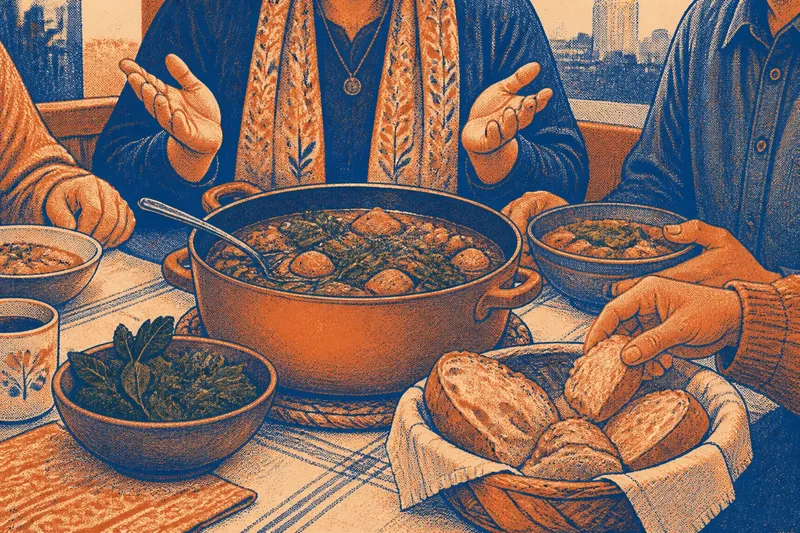
Say a family moved from a coastal town in one country to a city in another and kept its Sunday stew as a regular gathering. In the new city, the cook cannot find the leafy herb used in the old recipe, so she chooses a locally sold green; an evening shift means two relatives arrive later, and a cousin brings bread while an aunt begins with the family’s customary blessing. The resulting supper has a different flavour and a more staggered start, while those present can point to the blessing and shared stew as links to the meal they carried with them.
What do people ask?
How can I tell if a meal travelled?
Look for a connection participants make between the gathering in one place and its continuation in another, such as a remembered recipe, name or ritual. A dish that happens to resemble another is not enough to establish that journey.
Why do recipes change after migration?
Ingredients, kitchen space, schedules, taste and dietary needs can all influence a recipe. Ask the cook which factors mattered in this instance instead of attributing every alteration to migration alone.
Can a meal stay familiar with new ingredients?
It can, if participants still recognise valued parts of the occasion, such as its shared serving, welcome or place in the family calendar. Their answers may differ, so describe whose sense of familiarity you are reporting.
What if family memories conflict?
Keep the accounts separate and identify who recalls each detail. If nobody can resolve a disagreement, say that the memory is disputed rather than inventing one tidy version.
Describe the journey
Imagine that you are writing a note about the stew in the example. Start with the inputs: one remembered recipe from the coastal town, a missing herb in the new city, an available local green, relatives arriving after work and the aunt’s blessing. Then record the actions: the cook substitutes the green, the cousin brings bread, and the family begins eating as people arrive. The observable result is a stew with a changed taste, a later and less simultaneous meal, and a ritual that participants themselves identify as familiar. If they disagree about whether the green belongs in the dish, include both views rather than deciding for them.
For shared meals that travel, the most useful account names both places and explains the choices made between them. Keep participants’ own reasons beside each detail: that way, the meal’s new form is not mistaken for a simple copy of the old one or for a break from it.