A Museum Visit Through One Object’s Route
Plan a museum visit around one object’s route, using gallery clues and label wording to build a focused story without rushing through the collection.
Which museum object can anchor a visit, and how do you follow its story without turning the gallery into a race? A museum visit through one object’s route works best when you choose an item that raises a clear question and use the displays to investigate it. Instead of tracing every material or owner, pay attention to how the museum arranges evidence and where its account leaves room for doubt.
Choose a useful question
Start with a question you can answer by looking and reading: how did this object function, what does its display suggest about its audience, or why is it shown alongside these particular items? Then scan the gallery for an object with a legible label and nearby displays that might help you answer.
- If your visit is short: Check whether the object and a related display are in the same gallery; if they are, follow that compact route, and if not, choose a nearby object instead.
- If you have more time: Check whether the label points to another gallery or a later use; if the map shows an accessible connection, add that stop, and if the route is impractical, stay with the local displays.
- If you are visiting with children: Check whether the object has an easy-to-recognise purpose, such as a musical instrument or hand tool; if it does, invite a guess before reading, and if its function is unclear, choose an object with a more visible use.
- If the gallery is busy: Check whether you can read the label without blocking other visitors; if you can, make a brief note there, and if you cannot, record the gallery number and return when space opens.
- If you are interested in cultural exchange: Check whether the label identifies different communities, places or audiences; if it does, follow the museum’s stated connection, and if it does not, avoid inferring exchange from visual resemblance alone.
- If the label is sparse: Check whether a nearby caption or display provides context; if it does, use that evidence cautiously, and if it does not, choose another object rather than inventing a backstory.
These choices keep the visit manageable while directing your attention towards the museum’s interpretation: what it chooses to show, compare and leave unexplained.
Read the display
Look first at the object’s position. Is it shown alone, grouped with similar forms, placed beside a tool, or set within a reconstructed room? Notice what the display makes easy to compare and what it keeps separate. These are observations about the museum’s arrangement, not proof of what the object originally meant.
Then read the label for distinctions in wording. “Made for”, “used by”, “collected by” and “displayed with” describe different relationships. A label may state a documented fact, offer an interpretation or mark a gap in the record. Keep those categories apart in your notes rather than smoothing them into one continuous story.
Look for the people and perspectives named in the text. Does it identify a maker, user, collector or community, or does it leave some of them unnamed? Does a nearby display provide another account, or does the museum explain why information is missing? Treat omissions as a reason to ask what the display can support, not as an invitation to guess.
Build a gallery path
Use the floor plan to choose only the stops that help answer your question. A route might move from the object to a related tool, then to a display showing how the museum compares it with another item. Each stop should add a distinct clue; if it merely repeats what you already know, skip it.
Use a notebook or your phone’s notes app if the museum allows it. Write the object’s name, gallery location and the exact label words that qualify a claim, such as “possibly” or “attributed to”. Note one observation about the display and one question it leaves open. Check the museum’s rules before taking photographs, and do not copy an entire label when a few precise phrases will do.
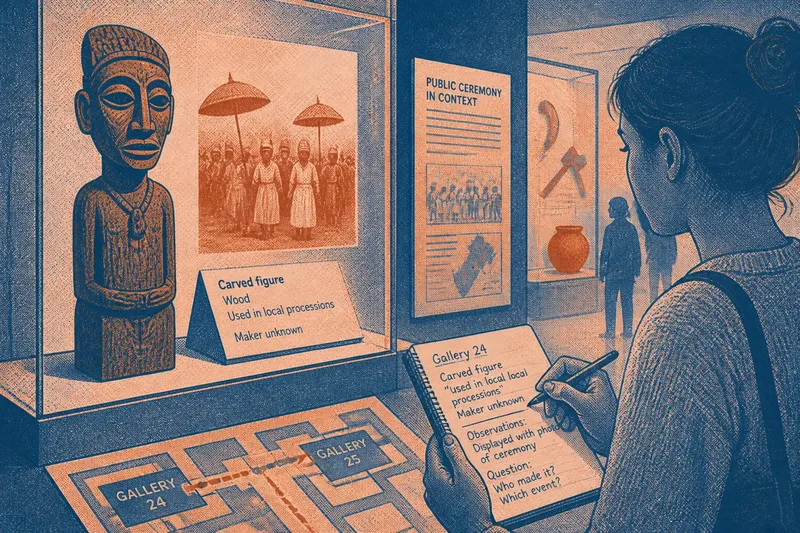
Say you have a short visit and notice a carved wooden figure displayed beside a photograph of a public ceremony. The label says the figure was “used in local processions” but does not identify who made it. You note that wording, check the map, and find a nearby panel describing the ceremony; it names the community involved but does not connect this particular figure to a specific event. Your route supports a careful account of the figure’s stated use and the context of the ceremony, while leaving its maker and exact history unresolved.
Questions about the visit?
How do I choose one object?
Choose an object with a question you can explore through its label and nearby displays. If neither offers useful context, select another rather than filling the gaps with assumptions.
Should I follow the label or the map?
Use the label to identify a worthwhile connection and the map to decide whether it fits your visit. If the related gallery is closed or far away, keep to accessible displays that add relevant context.
What if the object’s history is uncertain?
Record what the museum states, what it presents as a possibility and what remains unknown. Do not turn a tentative attribution or missing name into a firm claim.
Can I do this with a group?
Ask each person to notice a different part of the display, such as its placement, label wording or neighbouring objects. Compare observations at the next stop, separating what the museum says from what the group infers.
Leave some things aside
It is not worth trying to read every label, photograph every object or connect displays simply because they look alike. Those tasks can crowd out the question you came to explore. Choose stops that add evidence or perspective, and leave unrelated galleries for another visit.
Before you leave, check your notes: can you distinguish what the museum states from what you observed and what remains uncertain? If those categories have blurred, return to the label and adjust your wording. A museum visit through one object’s route becomes more useful when you carry away not only a story, but also a clear sense of how the display supports it.